
Article
Why Startups Are Building Teams in North Macedonia
At a Glance
The main reason startups build teams in North Macedonia is talent, with cost savings following as a welcome bonus. The country produces a steady stream of computer science and engineering graduates, its workforce ranks among the most English-fluent in Europe, and the developers, marketers, and support staff coming out of its universities and outsourcing firms have spent years working directly with clients across Western Europe and the Nordics. Add an EU-aligned time zone, a stable flat 10% tax regime, and hiring costs that run well below Western European salaries, and it becomes clear why founders are building real, long-term teams here rather than treating the country as a place to offload overflow work. For a founder trying to hire well without lowering the bar, North Macedonia has become one of the more compelling places in Europe.

What is making North Macedonia attractive to startups right now?
Startups are drawn to North Macedonia because it offers a mix that's hard to find in one place: a well-educated, English-fluent workforce, sitting in the same time zone as most of the EU, capable of the client-facing work international companies need. The country sits in the Central European Time zone, so daily standups and client calls happen without anyone logging on at 5 a.m. Its universities send a steady stream of computer science and engineering graduates into the workforce, many of whom have spent years serving international clients through freelance platforms or outsourcing firms based in Skopje and Bitola. The government has also spent the past decade courting foreign investment in tech, offering incentives to companies that set up development centers in the country as part of a deliberate push to position North Macedonia as a nearshoring destination, one that now competes with Poland, Romania, and Serbia for the same pool of European companies looking to hire technical talent without opening a full subsidiary abroad. Hiring costs that run well below Western Europe make the decision easier, but for most founders they're the tiebreaker, not the main reason.
Is North Macedonia's talent pool skilled enough for tech work?
North Macedonia's talent pool has grown well past the point of being an unproven bet. The country's ICT sector was valued at roughly $600 million in 2024 and has grown by 71% over the past three years, built largely on local companies that develop software and services for clients abroad rather than the domestic market:
- North Macedonia counted 1,957 economically active ICT companies and employed just over 15,000 people, as of the most recent detailed sector mapping by MASIT, the country's ICT industry association, with more than 60% of software and IT services revenue coming from exports.
- North Macedonia's IT market crossed the $1 billion mark by 2020, according to reporting by The Recursive, a Central and Eastern European tech news outlet.
- Net ICT exports grew 18% in 2023 alone, according to North Macedonia's national investment promotion agency.
- On the EF English Proficiency Index, North Macedonia ranks 17th out of over 100 countries worldwide, well above the global average score, putting its English fluency ahead of several EU member states.
Skopje in particular has developed a visible tech scene, with local meetups, coworking spaces, and homegrown startups that have raised international funding, reinforcing that working for a foreign company doesn't require leaving the country. Founders who have hired there generally describe the talent bar as comparable to more expensive Eastern European markets, with the added advantage of a workforce that hasn't been picked over as heavily by larger outsourcing firms, and the same strength shows up beyond engineering, in marketing, customer support, and other operational roles that international companies increasingly staff out of North Macedonia.
How much does it cost to hire a developer in North Macedonia?
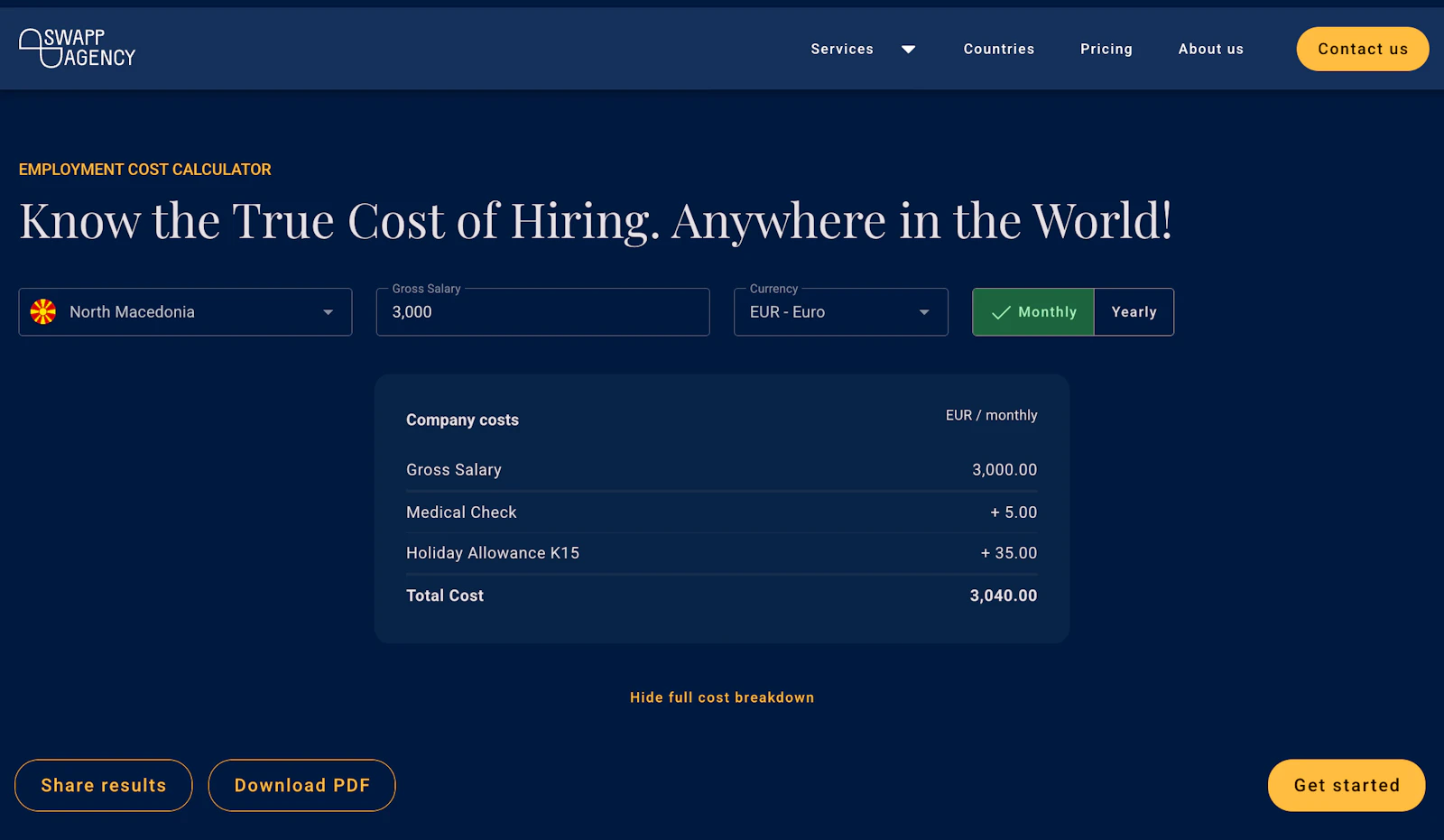
A junior developer in North Macedonia typically costs around €900 a month net, and pay climbs from there with experience, often reaching €3,000 to €4,000 a month net for senior, specialized developers. Hiring the same experience level in Denmark generally costs three to four times more for a typical mid-level hire, with the gap widening further for junior roles and narrowing somewhat at the senior end.
The figure that applies to a specific role depends on the tech stack, seniority, and how competitive the offer needs to be against other remote-first employers, so treat any blanket average with some caution. Our salary calculator factors in gross pay plus North Macedonia's mandatory contributions, so you can see the full cost of a specific hire rather than working from a rough estimate. For a detailed breakdown on the exact role you're hiring for, our team can walk through the numbers directly, and can help find the right candidate in North Macedonia through our recruitment service.
What are the legal risks of hiring in North Macedonia without a local entity?
Hiring directly in North Macedonia without a local entity exposes a company to two main risks: an administrative burden that rarely pays off for a one- or two-person hire, and potential permanent establishment exposure if the arrangement is structured incorrectly. Setting up a legal entity to do that involves registering a business with North Macedonia's Central Registry, opening a local corporate bank account, running local payroll, and staying compliant with the Law on Labour Relations, before a single person can even be paid. For a company hiring one or two people, that process rarely makes financial sense, and it can trigger unexpected tax obligations if a foreign company ends up operating through local employees without the right structure in place.
How to hire in North Macedonia without a local entity
Most startups skip registering a company in North Macedonia and hire through an Employer of Record instead. In practice, that looks like:
- Pick an Employer of Record with its own legal entity in North Macedonia. A provider that subcontracts to a local partner adds a layer of risk and slower response times. One with its own entity, such as Swapp Agency, handles the employment relationship directly.
- Agree on the role, salary, and start date. The Employer of Record turns this into a compliant local employment contract under the Law on Labour Relations.
- The Employer of Record registers the employee for mandatory pension, health, and unemployment contributions, and takes over monthly payroll and tax withholding.
- The startup manages the day-to-day work. Tasks, tools, performance reviews, and team integration stay with the startup, exactly as they would with a direct hire.
- If the relationship ends, the Employer of Record handles notice periods and severance under North Macedonian law, including the tiered severance schedule tied to years of service.
This path typically takes days rather than the weeks or months a full entity registration would require.

FAQ
Is North Macedonia part of the EU?
No. North Macedonia is an EU candidate country, not a member state. It received candidate status on December 17, 2005, and formal accession negotiations opened on July 19, 2022, though progress has since stalled over a constitutional amendment tied to Bulgaria's recognition demands.
What is the corporate tax rate in North Macedonia?
North Macedonia has a flat 10% corporate income tax rate, one of the lowest in Europe, alongside a flat 10% personal income tax rate on employment income.
What language do developers in North Macedonia speak?
Macedonian is the official language, but English proficiency is strong across the technical workforce. North Macedonia ranks 17th globally on the EF English Proficiency Index, ahead of several EU member states.
Can a startup hire in North Macedonia without opening a local entity?
Yes. A startup can use an Employer of Record to hire employees in North Macedonia legally without registering its own business entity in the country.
What is the time zone difference between North Macedonia and Western Europe?
North Macedonia is in the Central European Time zone, the same as most of continental Europe, and one hour ahead of the UK and Ireland.
How does hiring in North Macedonia compare to hiring in Poland or Romania?
North Macedonia offers similar time zone and skill advantages to Poland and Romania, generally at a lower cost, though the gap has narrowed as North Macedonian developer pay has climbed in recent years, with lead and architect-level roles now reaching the equivalent of roughly €1,200–5,300 a month net according to local salary data from Mojaplata.mk. The North Macedonian talent pool is also smaller, since the country has a much smaller population and a less mature outsourcing industry than Poland or Romania.