
Article
How to Legally Hire in Iceland Without an Entity
The short answer
You can legally hire employees in Iceland without opening a local company. The fastest, most compliant route is through an Employer of Record (EOR), which acts as the legal employer on your behalf, handling contracts, payroll, tax, and contributions from day one. Typical time to first hire via EOR is around 1 to 2 weeks, while hiring via entity setup can last anywhere near 3 and 6 months.
Let's dive into more details...

Introduction
Iceland tends to surprise people. It's a country of just 380,000, smaller than many European cities, yet it punches well above its weight when it comes to talent. The workforce is highly educated, almost universally English-speaking, and deeply comfortable with technology. And for foreign companies looking to establish a presence in the Nordic market, Iceland is increasingly on the radar.
The question most HR teams and founders hit early is the same one: do we need to set up a company in Iceland first? For the vast majority of businesses, especially those hiring fewer than ten people or exploring Iceland before making a long-term commitment, the answer is no. There's a cleaner, faster, and considerably cheaper way to do it.
What Are Your Options as a Foreign Employer?
When a foreign company wants to bring on an Icelandic employee, there are three routes. Each one suits a different stage of growth, and it is worth understanding all three before committing to any of them.
1. Set up a local Icelandic entity
You register a private limited company, known as an Einkahlutafélag, take on direct employer status, and manage all hiring, payroll, and compliance yourself. It is the right route for businesses building a permanent, large-scale presence in the country, but the setup process takes 3 to 6 months, costs €5,000 to €15,000 in legal and administrative fees, and requires ongoing local HR and accounting expertise to maintain.
2. Hire independent contractors
No entity is required, and the arrangement is flexible. The risk is that Iceland's Directorate of Labour takes worker misclassification seriously. If your contractor works exclusively for you, follows your direction, and operates like an employee in practice, Icelandic authorities can reclassify them, exposing you to back taxes, social contributions, and penalties. This route only works well for genuinely independent, project-based work.
3. Use an Employer of Record (EOR)
An EOR becomes the legal employer of your hire in Iceland. Your team member works for you day-to-day, but the EOR issues the employment contract, runs compliant payroll in Icelandic Króna, handles social security contributions, pension, and tax filings, and ensures you stay on the right side of Icelandic labour law. You pay the EOR a monthly fee; they handle everything else. Swapp Agency holds its own legal entity in Iceland, meaning we act as the employer directly with no local partners and no subcontracting.
EOR vs. Setting Up an Entity in Iceland
Here is how the two main routes compare for a foreign company looking to hire in Iceland:
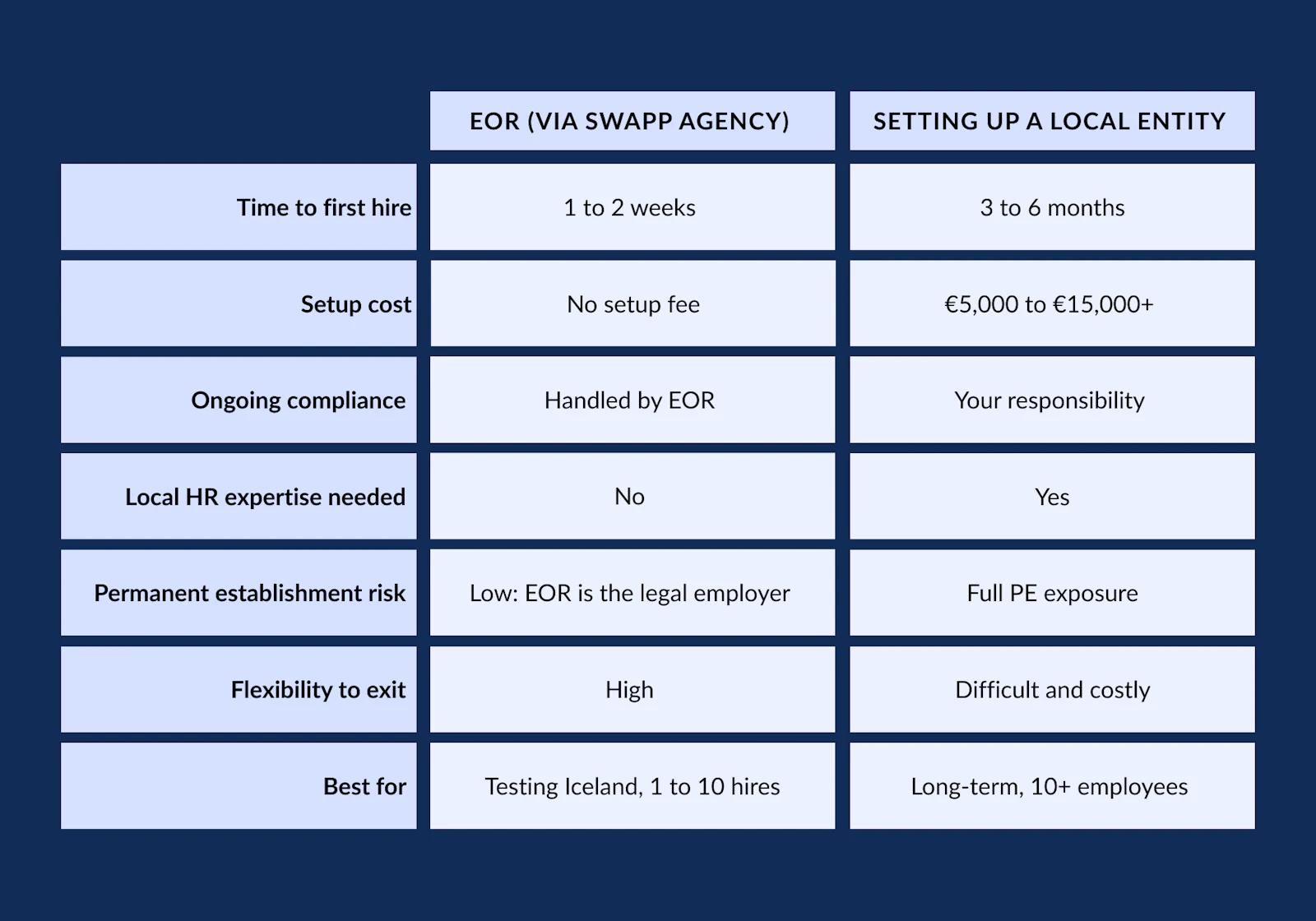
Costs and timelines are indicative. Swapp Agency operates a legal entity in Iceland, making us one of the few EOR providers with true on-the-ground presence.
Key Icelandic Employment Laws You Need to Know
Iceland's labour law is robust and heavily shaped by collective bargaining agreements (CBAs) negotiated between trade unions and employer associations. Any employee you hire through an EOR will be covered by these agreements. Here is what matters most:
Contracts: Written employment contracts are mandatory for any role lasting more than one month at more than eight hours per week. They must comply with the applicable CBA for your employee's sector and include job title, salary, working hours, holiday entitlement, and probation terms. There is no requirement for contracts to be written in Icelandic, but they must be fully compliant with local employment standards.
Salary: Iceland has no single statutory minimum wage. Wages are set by sector through collective agreements. As of early 2026, the starting minimum under most CBAs sits at approximately ISK 513,000 to 515,000 per month (around USD 3,650). The average gross monthly salary nationally is ISK 720,000 to 760,000, roughly USD 5,100 to 5,400.
Working hours and overtime: The standard working week is 40 hours. Overtime is governed by the relevant CBA and must be compensated at the applicable premium rate.
Statutory leave: Employees in Iceland are entitled to:
- 24 days of paid annual leave per year
- 13 public holidays
- Up to 12 months of shared parental leave, split between parents, paid at 80% of salary
- Sick leave entitlements governed by the applicable CBA
Termination: Iceland does not allow at-will termination. Ending a contract requires a valid reason and must follow the notice periods set by the relevant agreement: one week during the three-month probation period, one month after probation, and three months once an employee has been with you for six months or more. Employees have the right to receive the reason for dismissal in writing.
Payroll Taxes and Employer Costs
Social security contribution (Tryggingagjald): Employers pay 6.35% of gross wages directly to the Icelandic treasury. This is paid entirely by the employer and is not deducted from the employee's salary.
Pension contributions: The total mandatory contribution is 15.5% of gross wages: 11.5% from the employer and 4% from the employee. If an employee opts into voluntary additional contributions of 4%, the employer must match with an extra 2%.
Income tax (PAYE): Iceland operates a progressive income tax system. Employers withhold income tax from employee salaries each month and remit it to the tax authorities. The municipal tax rate for 2026 is 14.94%. This is withheld from the employee's salary and is not an additional employer cost.
Employer cost summary (approximate, 2026):
- Social security contribution: 6.35% of gross wage
- Pension contribution: 11.5% of gross wage
- Total on-cost above gross pay: approximately 17.85%
Note: income tax is withheld from the employee's salary and is not an additional employer cost.
For full tax details and employment cost calculations, see our Iceland country page, which includes up-to-date income tax brackets, pension options, and employer obligations.

How the EOR Process Works in Practice
When you hire through Swapp Agency's EOR service in Iceland, here is what the process looks like:
- You identify your candidate. Swapp Agency is not involved in the recruitment decision. You find the person you want to hire. If you’d like us to help with recruitment too, we offer that as a separate service.
- We send you a salary breakdown estimate. You inform us about the chosen employee salary, and we send you a full breakdown of gross salary, employer contributions, and total employment cost before any commitment.
- We issue a compliant employment contract. Swapp Agency, as the legal employer in Iceland, drafts and signs a locally compliant contract with your new team member.
- The employee starts work. Typically within 1 to 2 weeks of initiating the process. We handle registration with Icelandic tax and social security authorities.
- We manage ongoing payroll and compliance. Monthly payroll in ISK, social contributions, tax filings, and any HR matters, all handled by our team.
What About Non-EEA Nationals?
If your prospective hire is a citizen of an EU or EEA country, which includes all EU member states, Norway, and Liechtenstein, they can work in Iceland freely without a work permit. They will need to register their right of residence with Registers Iceland if staying longer than three months, but there is no employer-side application process, and EOR works smoothly for these hires from day one.
For nationals from outside the EEA, EOR is not the right route, and it is worth being upfront about why. Non-EEA employees require both a work permit and a residence permit before they can legally start work in Iceland. Under Icelandic law, those permits must be tied to an employer with its own registered legal entity in the country. An EOR arrangement does not meet that requirement. You can read more about the permit process on the Icelandic Directorate of Labour website.
Swapp Agency does offer work permit assistance for non-EEA hires, but this is a separate service from our EOR offering. To employ a non-EEA national in Iceland, you would first need your own registered Icelandic company. Swapp can then help you navigate the permit application once that entity is in place. If that is your situation, get in touch with our team directly and we will map out the right path.
When Does It Make Sense to Set Up Your Own Entity?
EOR is not the right answer for every company. Setting up your own Icelandic entity makes more sense when:
- You are hiring more than 10 to 15 employees in Iceland and the cost of EOR fees exceeds entity maintenance costs
- You need a permanent registered business address in Iceland for regulatory or client reasons
- Your business involves activities that require a local licence or authorisation
- You are making a long-term, strategic commitment to the Icelandic market
Most companies start to evaluate the entity crossover point somewhere around ten to fifteen employees. Below that, the flexibility and lower overhead of EOR almost always makes more sense.
Ready to hire in Iceland?
Swapp Agency has a legal entity in Iceland. We handle employment contracts, payroll, social contributions, and full compliance so you can make your first hire in days, not months.
See Iceland pricing and get a free salary estimate at swappagency.com
Swapp Agency operates a legal entity in Iceland. This article is for informational purposes only and does not constitute legal or tax advice.