
Article
EOR vs. PEO: Which Is Right for Global Hiring?
At a Glance
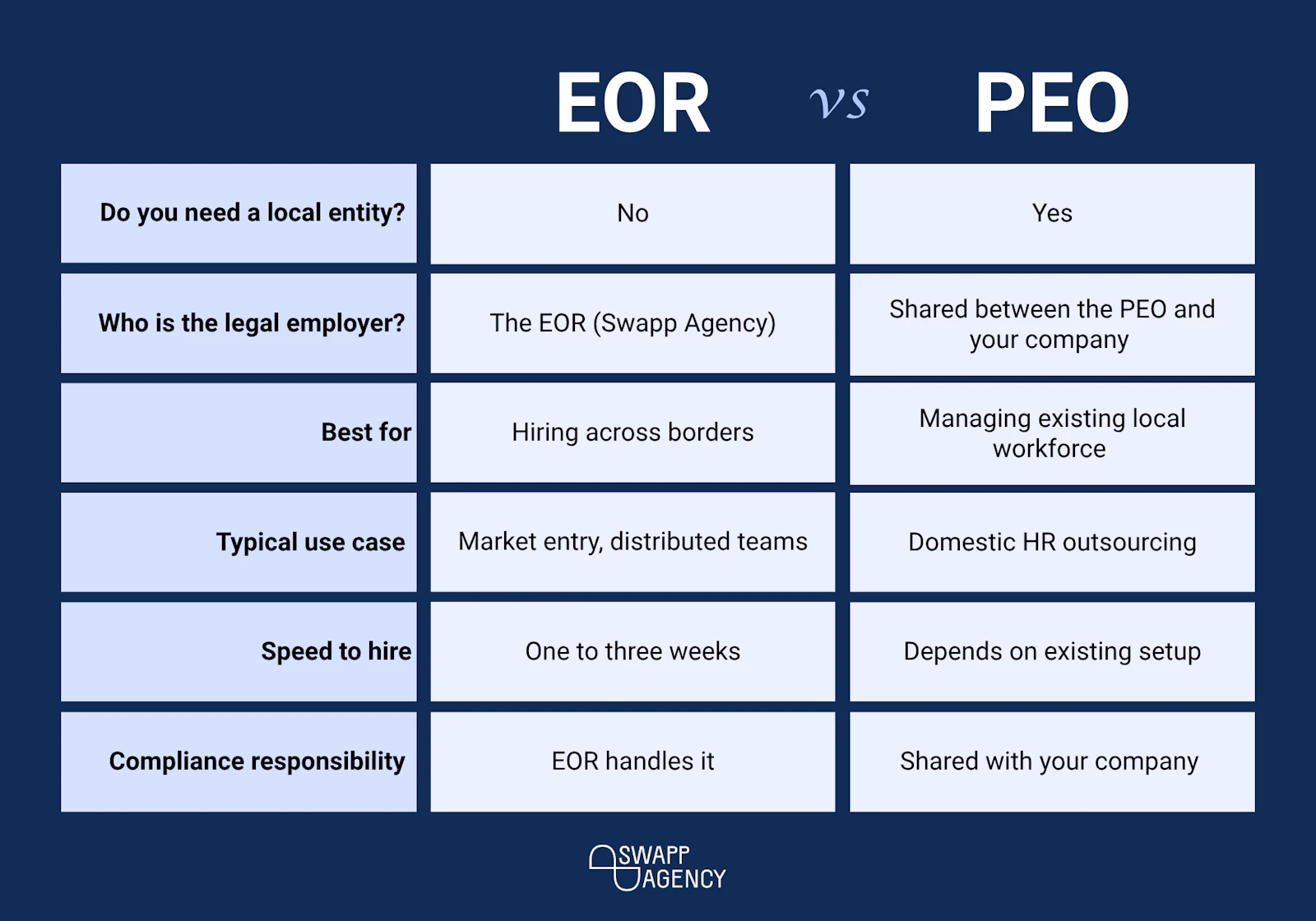
EOR and PEO are two different employment models used by companies hiring internationally. An EOR employs workers on your behalf in countries where you have no legal entity. A PEO co-employs workers alongside your existing entity in a country where you are already registered. The right choice depends on whether you have a local entity in the country you are hiring in, and in most cross-border hiring situations, you do not.

Introduction
If you are researching how to hire someone in another country, you will quickly come across two terms: Employer of Record and Professional Employer Organisation. They sound similar and both involve a third party handling employment administration, but they work in fundamentally different ways and suit very different situations.
Understanding the distinction matters before you make a decision, because choosing the wrong model can create compliance problems that are expensive to unpick later.
What Is an Employer of Record?
An Employer of Record is a company that becomes the legal employer for your workers in a country where you do not have a registered legal entity. The EOR signs the employment contract, runs payroll, withholds taxes, handles social contributions, and ensures compliance with local labour law. You direct the employee's day-to-day work, the EOR handles everything else on paper and in practice.
This model exists specifically to solve the problem of hiring across borders without setting up a local company first. Setting up an entity in a new country takes months and costs significantly more than most companies expect, particularly for one or two hires. An EOR removes that requirement entirely.
What Is a Professional Employer Organisation?
A PEO operates through a co-employment arrangement. Rather than becoming the sole legal employer, the PEO shares employer responsibilities with your company. You remain on the employment contract as the employer of record, and the PEO takes on the HR administration, payroll processing, benefits management, and compliance support alongside you.
Because the PEO model requires your company to already have a legal presence in the country, it is primarily used domestically, a company in the US using a PEO to manage HR administration across multiple states, for example, or a company in Germany using a PEO to streamline payroll across a large workforce it already employs locally.

When EOR Is the Right Choice
EOR is the right model for most cross-border hiring situations. If any of the following apply, EOR is worth considering seriously.
You want to hire in a country where you have no entity
This is the primary use case. EOR removes the need to register, maintain, and eventually wind down a local company just to employ one or two people.
You are testing a new market
Hiring a local sales or business development representative through an EOR before committing to a full entity setup is a significantly lower-risk way to validate a market. If the expansion works, you can set up your own entity later. If it does not, you have avoided a considerable amount of sunk cost.
You need to hire quickly
Setting up an entity in most countries takes three to six months. An EOR can have a compliant employment contract in place within one to three weeks of a candidate accepting an offer.
Your team is distributed across multiple countries
Managing separate entities in five or ten countries is administratively demanding and expensive. A single EOR partner can handle employment across all of them, reducing the number of relationships and compliance obligations you are managing simultaneously.
When PEO Is the Right Choice
PEO makes sense in a different set of circumstances. It is a legitimate model for companies that already have an established local presence and want to offload the administrative side of employment without giving up the direct employment relationship.
You already have a local entity and a growing workforce
If your company has a registered subsidiary or branch in a country and is managing a significant headcount there, a PEO can take on payroll, benefits administration, and HR compliance on your behalf. This frees up internal resource without requiring you to restructure how employment works.
You want to standardise HR across multiple locations in the same country
In markets like the US, where employment law varies significantly by state, a PEO helps companies apply consistent HR policies and benefits packages across a dispersed domestic workforce. This is one of the strongest use cases for PEO, and it is largely a US-specific model for this reason.
You want access to better employee benefits through pooled purchasing
Because PEOs pool employees from multiple client companies, they can often negotiate better rates on health insurance, retirement plans, and other benefits than a single company could on its own. For smaller companies with a local entity trying to offer competitive benefits, this can be a meaningful advantage.
You want to retain direct employment relationships
Some companies prefer to remain a party to the employment contract for legal or cultural reasons. PEO allows this because the arrangement is co-employment rather than a full transfer of the employer role to a third party.
EOR vs PEO: A Practical Comparison
What About Compliance?
One point worth being clear on: in both models, compliance responsibility sits with whoever is the legal employer. With an EOR, that is the EOR provider. With a PEO, compliance is shared, which means your company retains some of the risk.
This is one reason many companies prefer EOR for international hiring. When an EOR makes a compliance error in North Macedonia or France or Ireland, the liability sits with the EOR rather than your business. With a PEO co-employment arrangement, your company remains partially exposed because you are still a party to the employment relationship.
For companies hiring internationally for the first time, EOR typically offers a cleaner separation of risk.
Which Model Does Swapp Agency Offer?
Swapp Agency operates as an Employer of Record across 160+ countries, with its own entities in Iceland, Sweden, Denmark, Norway, Finland, Greenland, Faroe Islands, Åland Islands, Estonia, Lithuania, North Macedonia, Spain, Portugal, France, the United Kingdom, and Ireland.
This means that for most international hiring situations, a company hiring its first employee in Spain, a Nordic business building a development team in North Macedonia, a US company looking to employ someone in the UK without setting up a subsidiary, Swapp Agency can act as the legal employer directly without involving third-party partners.
We do not offer PEO services, and for most of the companies that contact us, EOR is the appropriate model for what they are trying to do.
Summary
EOR and PEO solve different problems. EOR is built for hiring across borders without a local entity. PEO is built for managing employment more efficiently when a local entity already exists. For companies hiring internationally, particularly those entering new markets or building distributed teams, EOR is the model that fits.
If you are unsure which model applies to your situation, the simplest question to ask is whether you have a registered legal entity in the country you want to hire in. If the answer is no, EOR is almost certainly the right starting point.

Frequently Asked Questions
What is the main difference between EOR and PEO?
An EOR becomes the sole legal employer for your workers in a country where you have no entity. A PEO co-employs workers alongside your company in a country where you already have a registered entity. EOR is designed for cross-border hiring. PEO is designed for domestic HR administration.
Do I need a legal entity to use an EOR?
No. That is the point of an EOR. You can hire compliantly in another country without registering a local company. The EOR provides the legal infrastructure needed to employ people in that market.
Do I need a legal entity to use a PEO?
Yes. A PEO requires your company to already have a legal presence in the country because the employment relationship is shared between the PEO and your entity.
Is EOR more expensive than PEO?
EOR typically costs more per employee than a PEO arrangement, but it removes the need for a local entity, which carries its own significant costs, registration fees, local accounting, ongoing compliance, and the administrative burden of maintaining a company in a foreign jurisdiction. For small headcounts in a new market, EOR is almost always more cost-effective overall.
Can I switch from EOR to a direct entity later?
Yes. Many companies use EOR to hire their first one or two employees in a new market and then transition to their own entity once the market is proven and the headcount justifies the investment. An EOR makes it possible to start hiring before that decision needs to be made.